
On 27 August 1926, New York stopped for Gertrude "Trudy" Ederle.
Three weeks earlier, the 20-year-old New Yorker had become the first woman to swim the English Channel. In the chronology used by the Trudy Ederle Foundation she was in the water for 14 hours and 34 minutes.
"Nearly two hours faster than the men's record then standing."
The swim had ended on a shingle beach at Kingsdown, England. The public story did not end there. It crossed the Atlantic with her.
One hundred years later, the applause is gone. The question remains.
Does New York remember Trudy?
The city prepares
The welcome was planned before her ship reached New York.
The administrative record survives in the files of the Mayor's Committee on Receptions to Distinguished Guests, held by the New York City Municipal Archives. Mayor James J. Walker asked Grover Whalen, the committee's chairman, to organise the welcome - sirens in the harbour, a water salute from the fireboats, a procession up Broadway to City Hall. Police, fire, docks, street-cleaning and other municipal departments were involved. Athletic clubs and the Women's Swimming Association, where Trudy had trained, were represented as well.
What looked spontaneous from the street was a major civic operation.
From the harbour to Broadway
Trudy returned aboard the Cunard liner Berengaria. The city steamer Macom carried members of her family and the official reception party into the harbour to meet her.
The welcome began on the water. Sirens sounded. Fireboats sent water into the air. Reception boats crowded with relatives and officials approached the liner.
The Ederles came in force. The Associated Press counted "42 cousins and aunts, not to mention uncles and brothers, according to one of them who counted noses on the two tugs that bore the big reception down the river this morning."
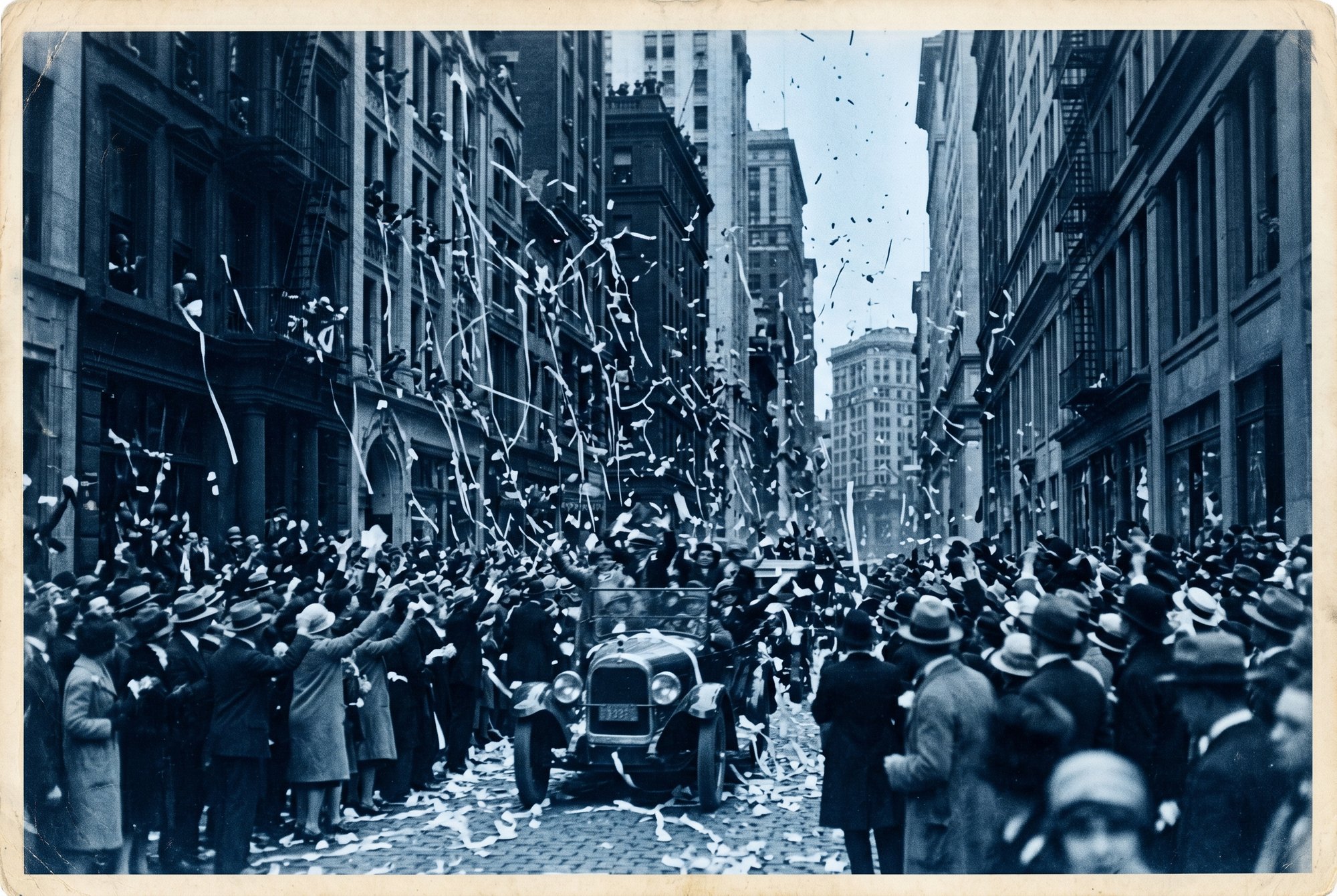
From the Battery, the welcome moved onto Broadway. The parade proceeded north through the corridor later known as the Canyon of Heroes. Paper poured from office windows. People pressed into the street. The committee's timetable set the procession to leave at 11:45 a.m. and reach City Hall at 12:15 p.m.
How many people were there is a question the sources do not answer. The wire report filed that day gives no figure. Neither does the city's own account. What the Associated Press did record is the comparison:
"Gertrude Ederle was given a homecoming ovation today as New York has never given a woman before. Packed throngs that witnessed her triumphant procession up the canyon of lower Broadway were estimated as greater than those that welcomed returning heroes after the World war."
That is the measure the day itself used. It needs no number.


When the celebration became a crush
The welcome also had a physical reality that triumphal retellings tend to leave out.
The crowd outside City Hall, where Mayor Walker presented Trudy with a scroll commemorating her swim, "reached such proportions that 100 extra policemen were called to prevent serious trouble," the Associated Press reported. "Six women and children were wounded in the rush of humanity."
Whalen later recalled that the police had underestimated the turnout. After the ceremony, the mayor escorted Trudy toward the City Hall steps for photographs. A surge of people moved toward them. A police officer lifted her bodily and carried her back inside while other officers helped the mayor reach safety.
New York had come to honour her. For a moment, the city nearly overwhelmed her.
That contrast matters. The parade was a triumph. It also foreshadowed the pressure that follows extraordinary public achievement - the sudden conversion of a private person into public property.
Not her first journey through the Canyon - but the first that was hers
Trudy had already travelled through the Canyon of Heroes in 1924, as a member of the United States Olympic team returning from Paris. She had won a gold medal in the 4 × 100 metre freestyle relay and bronze medals in the 100 and 400 metre freestyle.
The two occasions are distinct. On 6 August 1924, New York welcomed a team. On 27 August 1926, the city honoured Gertrude Ederle for what she had done herself.
The Downtown Alliance's chronology of ticker-tape parades records them separately: the United States Olympic athletes on 6 August 1924, and, as entry number 19, "August 27, 1926. Gertrude Ederle, first woman to swim the English Channel."
The name beneath New York's feet
Today the parade is marked by a granite strip set into the sidewalk of Lower Broadway, just north of Beaver Street, near 26 Broadway. It carries her name and one line: first woman to swim the English Channel.
It is easy to miss amid the daily foot traffic.
One hundred years later
On the exact centennial of the parade, the Trudy Ederle Foundation is marking the day with a deliberately quiet gesture.
A wreath is being placed at the Canyon of Heroes marker. There is no ceremony, no speech and no reenactment. No officer, staff member or spokesperson of the Foundation is appearing at the location. An independent filmmaker commissioned for the project is documenting the marker, the street, and voluntary, unscripted responses from passers-by to one question:
Do you know who Gertrude Ederle was?
Only responses from participants who consent to publication will be used. The purpose is not to catch anyone out. The short film is not a representative survey of New York. It asks what cities, institutions and generations choose to carry forward.
A century ago, New York knew her name.
What happened after the applause
The parade was not the end of Trudy Ederle's life. It was the beginning of a more complicated chapter.
Fame brought opportunity, and it brought pressure. She had been losing her hearing progressively since childhood; in her later years the loss was severe. There was injury, and there were long years out of the spotlight. She went on to teach children with hearing impairments to swim.
That is where the Trudy Ederle Foundation begins its work - not at the moment of victory, but in the life that follows it. Its core field, Second Channel, addresses the transition after peak performance, when an athlete has to build a next identity once the structure, the attention and the certainty of competition have changed or gone.
Trudy crossed one channel in 1926. The rest of her life was another crossing.
A century ago, applause. Today, responsibility.
Remembering Trudy Ederle is not nostalgia. Her story asks what a society does with achievement after it has used the photograph, celebrated the record and moved on to the next name.
On 27 August 1926, Broadway stopped for Trudy.
On 27 August 2026, we return to the same street and ask what remains when the applause has faded.
Her name is still in the pavement. What comes next is not.
The Foundation's work begins where the applause ended. You can carry it one crossing further - $14.34, the time she spent in the water.
Give $14.34 →Sources
- New York City Municipal Archives, "New York Goes Wild Welcoming Trudy Home," republished 25 August 2026 (first posted 2023) - Link
- Associated Press dispatch, New York, 27 August 1926, as printed in the Oregon Statesman, 28 August 1926, page 1 - Link
- Files of the Mayor's Committee on Receptions to Distinguished Guests (Grover Whalen), New York City Municipal Archives, as published in the Municipal Archives feature above
- Downtown Alliance, New York's Ticker Tape Parades - Link
- Library of Congress, "Parade for Gertrude Ederle coming up Broadway, New York City, with large crowd watching," record 98510485 - Link
- Historical Marker Database, "August 27, 1926" (Canyon of Heroes marker) - Link
About the Trudy Ederle Foundation
The Trudy Ederle Foundation translates elite-sport expertise into societal health capital - in the spirit of Gertrude "Trudy" Ederle: movement, prevention, inclusion and responsible philanthropy. Its core field, Second Channel, focuses on the transition after peak athletic performance and the right to a next identity.
Press contact
Tobias Kolesnyk, Director Strategic Communication
tobias.kolesnyk@trudyederle.org
trudyederlefoundation.org