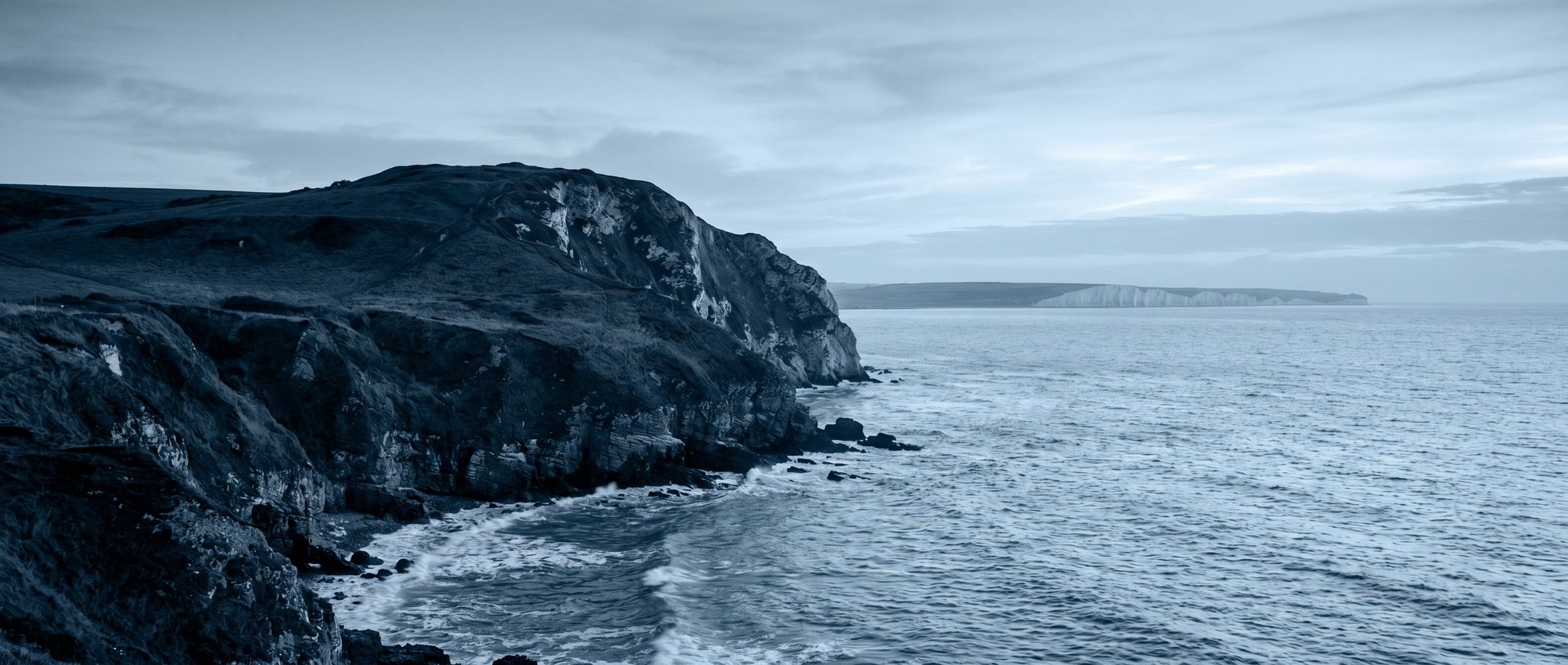
Cap Gris-Nez at dawn — the starting point of the Channel crossing

Fourteen hours,
thirty-one minutes —
and a new measure of the possible.

The story of Gertrude Ederle — from a New York summer cottage where a seven-year-old nearly drowns, to the English coast where, thirteen years later, that same girl walks out of the water and leaves a different world behind.

Born
October 23, 1905
Birthplace
Manhattan, New York
Died
November 30, 2003
Lifespan
98 years
Prologue

On the morning of August 6, 1926, a twenty-year-old New Yorker stepped into the cold water of the English Channel at Cap Gris-Nez. Fourteen hours later she walked out on the English coast. She had not only become the first woman to swim the Channel — she had broken the men's record by nearly two hours. It was a day that took the question of what women's bodies could do out of debate, and put it into history.

I.Chapter · 1905 — 1922

A daughter of Manhattan.

Gertrude Caroline Ederle is born on October 23, 1905, on Manhattan's Upper West Side. Her parents, Henry and Gertrud, are German immigrants from the Württemberg town of Bissingen — Henry runs a butcher shop on Amsterdam Avenue, where the family also lives. Trudy grows up among six siblings, the rumble of streetcars outside the window, and the German songs her mother sings while cooking.

Summers, the family travels to Highlands on the New Jersey shore. There, in the Atlantic, the first turning point of her life takes place: at age seven, Trudy falls into a pond and cannot pull herself out. She survives — barely. In many children, this would have left a phobia. In her, it leaves a decision.

Henry ties a rope around her waist and lets her jump from the dock again and again. She learns to swim by refusing to stop. By thirteen, she has joined the Women's Swimming Association of New York, one of the few places in the city where girls can train seriously. Charlotte Epstein, the WSA's chair, and Louis Handley — a pioneer of the American crawl — become her teachers.

By age nineteen she holds 29 amateur world and US records. The American press has begun to know her name. But it is the next two summers that will change everything.
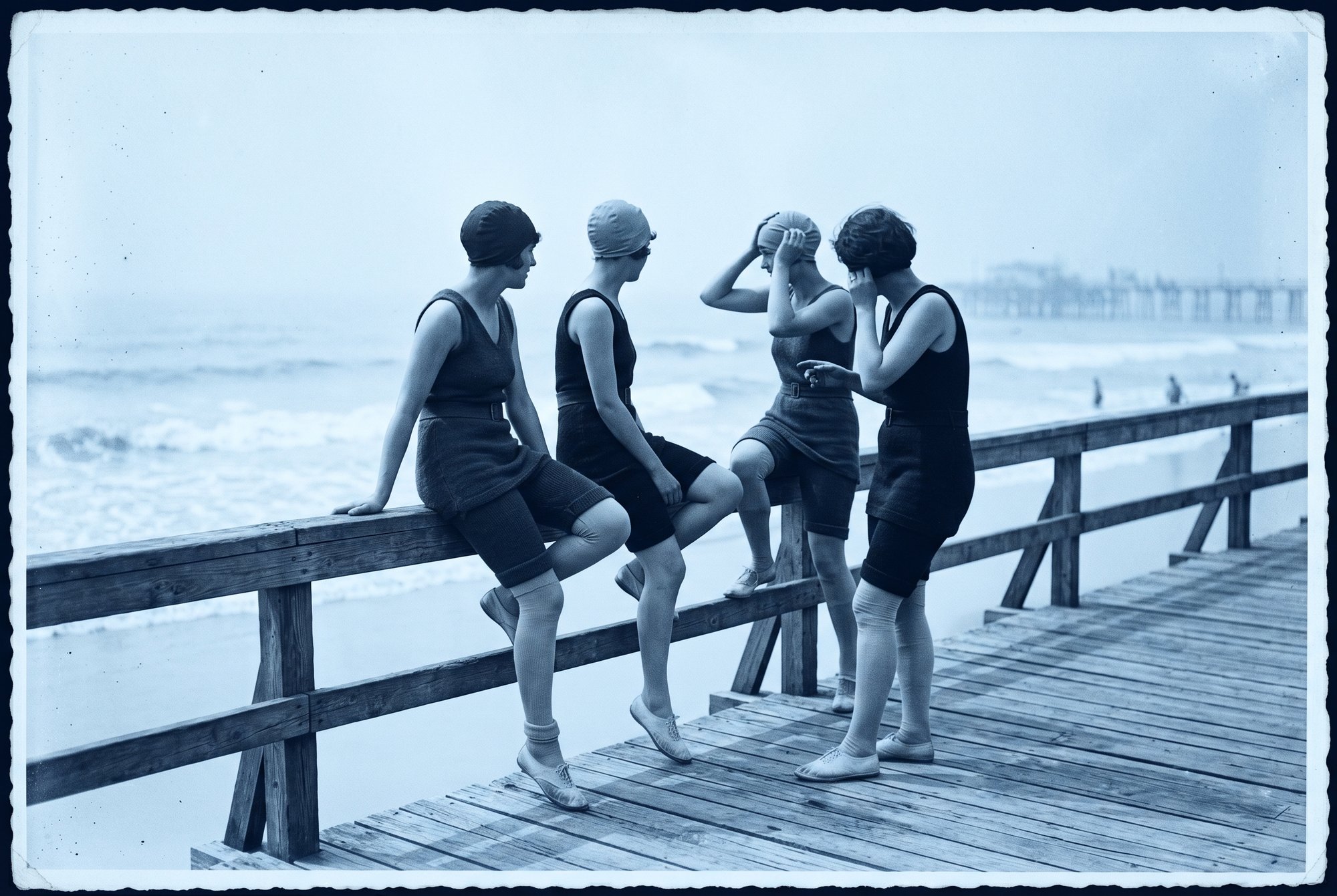
Young women in period bathing costumes on the American Atlantic coast, 1920s
Atmospheric reproduction · ca. 1922A generation of American swimmers trained by the Women's Swimming Association of New York. Trudy belonged to this cohort.
II.Chapter · 1924

The Olympics in Paris.

In the summer of 1924 Trudy is on an international stage for the first time. She is eighteen, part of the US women's team in Paris, and swimming in an Olympics that has come to be called the first "modern" one — the first with an athletes' village, live press coverage, and a standing-room audience.

She brings home three medals: gold with the American 4×100 m freestyle relay, bronze in the 100 m, and bronze in the 400 m. In her individual events she is beaten — partly because, even then, she swims against her own personal best, not against the others. It is a quirk that will become important later.

After Paris she receives an offer few athletes of her time received: sponsored funding for an attempt no woman had ever made. To swim across the English Channel.

Her trainer Louis Handley would later tell the press what made her swimming distinct: she was not racing the others. She was racing the water. In the open sea, that is the difference that matters.

III.Chapter · August 1925

The first attempt.

In the summer of 1925, Trudy makes her first attempt. She starts off Cap Gris-Nez in weather that the support boats describe as "workable, but unsettled". For eight hours and forty-six minutes she swims. Then comes the misunderstanding that will go down in sport history.

Her trainer, watching from one of the support boats, believes Trudy has gone unconscious — she is swimming with her face submerged in a wave trough, an energy-saving technique. Alarmed, he reaches out and touches her. Under the rules of the Channel Swimming Association, the attempt is over. Trudy is furious. She would have kept swimming, she says afterward. She would have made it.

The world writes her off. "Women cannot swim the Channel," several newspapers conclude. A sports columnist writes that "this is a job for men." Trudy doesn't listen. She returns to New York, trains for another year — and comes back.

"People said women couldn't swim the Channel. But I proved they could."— Trudy Ederle
Chapter IV · August 6, 1926

Fourteen hours,
thirty-one minutes.

What happened that day was a mixture of preparation, will, and a refusal to take an English question seriously.

07:05
Start
Cap Gris-Nez, France
21:39
Arrival
Kingsdown, Kent
14:34
Swim time
A new world record at the time
35 km
Distance
Actual swim — far longer due to currents
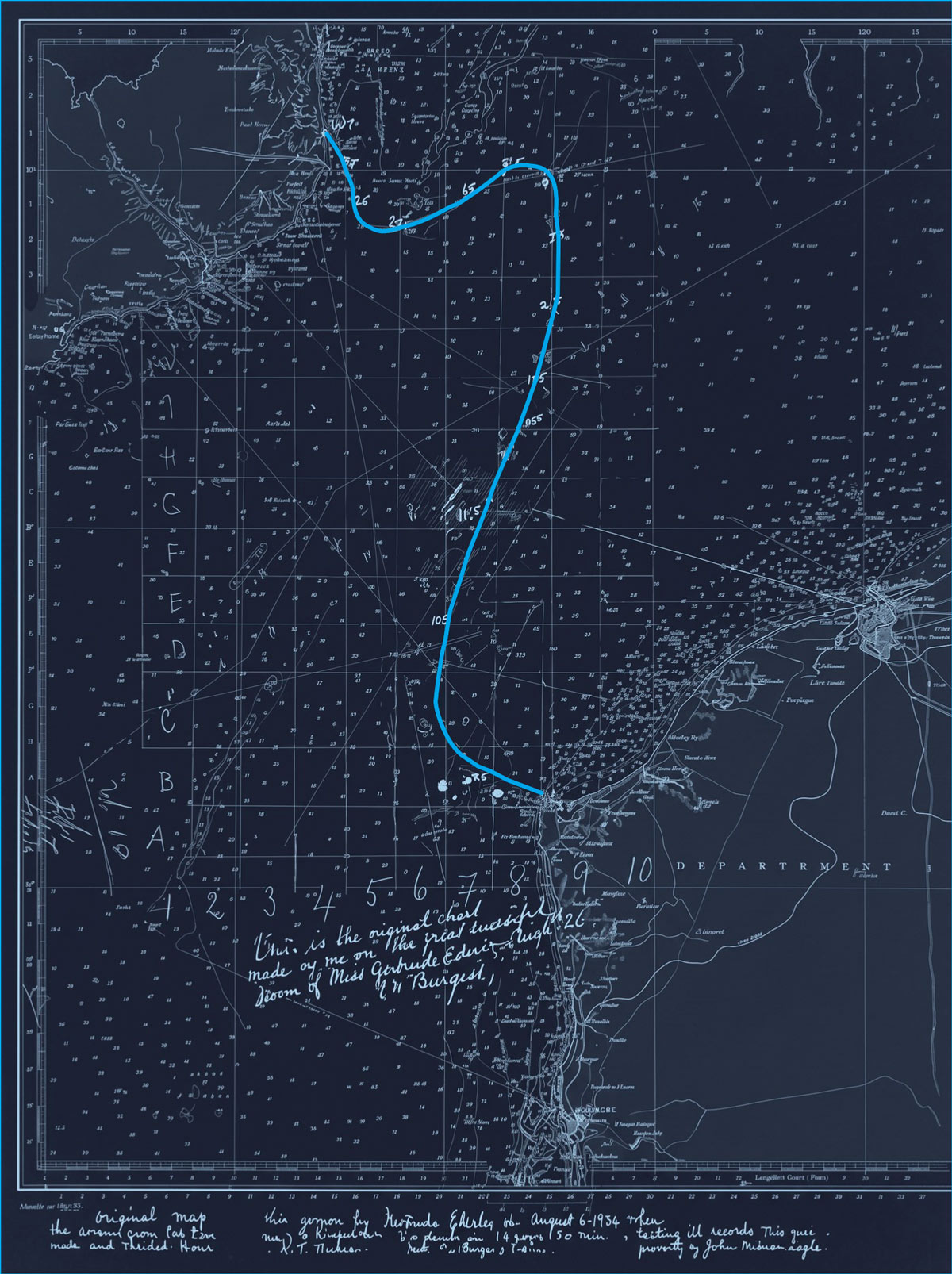
The crossing — Cap Gris-Nez → Kingsdown.
August 6, 1926 · 14:34 hrs · 35 km
Live tracking planned for August 6, 2026
Historische Karte der Kanalüberquerung

Across her fourteen-hour swim, flood and ebb tides alternated several times. The flood tide pushed her east at first, the ebb later pushed her back west — the actual track followed a pronounced S-curve. She swam roughly 35 Miles to cover a 33-kilometre straight-line distance, and even so, she landed east of the originally intended point. Fourteen hours, thirty-four minutes after starting, she emerged from the water at Kingsdown.

  • 07:05
    Cap Gris-Nez
    Trudy enters the water with two drops of olive oil in her eyes. Over her skin: a layer of lanolin, vaseline and lard against the cold. She wears a two-piece bathing suit — one of her own innovations, scandalous in its time but liberating to her stroke.
  • 10:00
    First third
    From a support boat the training team plays gramophone records — dance music, Trudy's favourites. She swims the American crawl, the technique perfected at the WSA under Louis Handley and unconventional at the time. The wind is from the west.
  • 13:00
    Mid-Channel
    The weather turns. Two-metre waves, the support boats rolling heavily. The trainer calls for her to come out — the sea is too rough. Trudy's reply, which everyone present will remember afterwards: "What for?"
  • 17:00
    Off the Kent coast
    Currents push her east of the planned landing. She has to aim for a different stretch of coast. Near the white cliffs of Dover she can see lights — and people on the beach with torches, marking her path.
  • 21:39
    Kingsdown, England
    She emerges from the water, stumbles up the shingle and stands. A British official, who knew nothing of her attempt, asks for her passport. Trudy laughs. 14 hours, 34 minutes — almost two hours under the existing men's record.
V.Chapter · August 27, 1926

Homecoming — and two million.

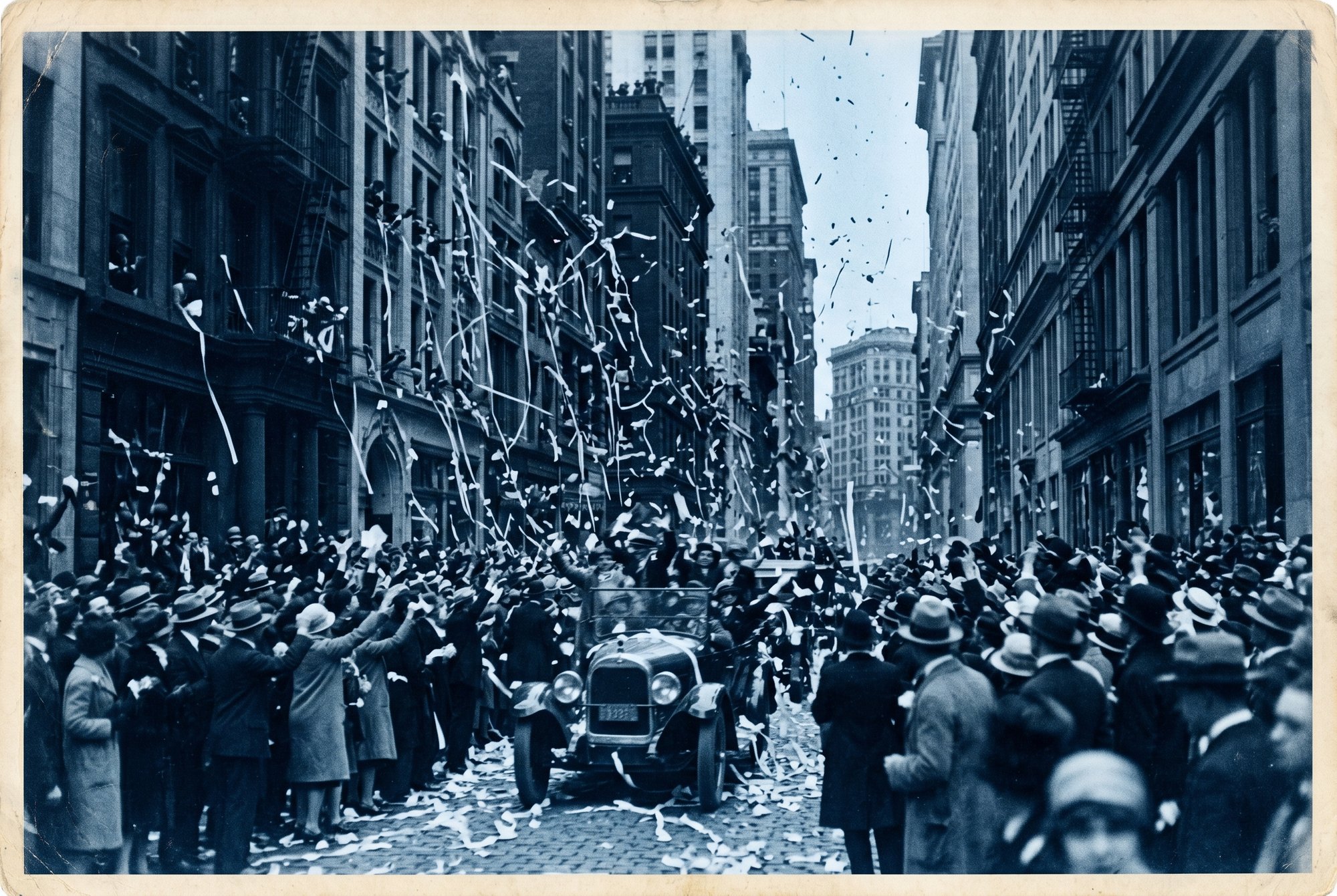
Three weeks later, Trudy returns to New York. What awaits her there, no one had predicted. The city greets her with one of the largest ticker-tape parades in its history. Estimates put two million people along the route through the Canyon of Heroes — more than would line the streets for Charles Lindbergh a year later.

She is received at the White House. President Coolidge calls her "America's Best Girl." Songs are written about her, dances named after her. Hollywood courts her with film offers. One endorsement contract after another lands on her table.

But the speed at which she becomes a public figure carries a cost. Trudy is an introverted young woman who loves swimming, not noise. What looks like triumph becomes a long exhaustion. In 1928 she suffers a nervous breakdown.

Atmospheric reproduction of a 1920s ticker-tape parade in Lower Manhattan
Atmospheric reproduction · 1926Confetti and paper streamers from the windows of office towers — the Canyon of Heroes greets its swimmer.
VI.Chapter · 1928 — 2003

The long life that followed.

What follows after 1928 is glossed over in most Trudy retellings — unfairly. It is the longest, and perhaps most important, phase of her life. It is the phase this Foundation honours.

In 1933 she falls down a staircase at home and seriously injures her spine. Doctors tell her she will not walk again, let alone swim. For four years she wears an orthopaedic corset. Then she begins to train again. In 1939 she swims at the opening of the New York World's Fair — no records, just a statement: she is back.

From childhood Trudy had had hearing problems following an ear infection. The Channel — fourteen hours in cold salt water — almost certainly accelerates the loss. By her later decades she is largely deaf. Rather than retreat, she begins to teach at the Lexington School for the Deaf in New York. For decades she teaches deaf children to swim — deaf to the voices who once told her what women could not do.

She never married. She had no children. She was inducted into the International Swimming Hall of Fame in 1965. She died on November 30, 2003 in Wyckoff, New Jersey — at the age of 98.

It is this second half of her life that is missing from most Trudy stories. A woman who had taken her body to the limit on a single August day in 1926 spent the rest of her life teaching others to find the water — children she could not hear. That is the lesson.

Chronology · 1905 — 2003

A life in thirteen stations.

The major waypoints of a ninety-eight-year life — from a birth in Manhattan to a final day in New Jersey, with one day in August 1926 in the middle that changes everything.

1905

Born in Manhattan

October 23 · Upper West Side, NYC

Gertrude Caroline Ederle, third child of Henry and Gertrud Ederle, German immigrants from Bissingen.

1912

Near-drowning

Highlands, New Jersey

At age seven, Trudy falls into a pond. Her father then teaches her to swim — by rope, off the dock.

1918

Joins the WSA

Women's Swimming Association · NYC

At thirteen, she joins the Women's Swimming Association of New York. Charlotte Epstein and Louis Handley become her coaches.

1922

First world record

880 yards freestyle

At sixteen she sets her first world record. By nineteen there will be twenty-nine.

1924

Olympic Games Paris

Games of the VIII Olympiad

One gold with the American 4×100 m freestyle relay. Two bronze in the 100 m and 400 m freestyle.

1925

First Channel attempt (failed)

August 18 · Cap Gris-Nez

After 8 hours 46 minutes the attempt is broken off due to a misunderstanding by her trainer. Trudy is furious.

1926

The English Channel

August 6 · Cap Gris-Nez → Kingsdown

First woman to swim the Channel. 14 hours, 34 minutes — almost two hours under the men's record. Three weeks later: a ticker-tape parade in NYC, ~2 million spectators.

1928

Nervous breakdown

New York

The weight of public attention takes its toll. Trudy retreats from the spotlight.

1933

Severe fall

NYC · spinal injury

She falls down a staircase at home. Doctors say she will not walk again. She wears a corset for four years.

1939

Comeback at the World's Fair

New York World's Fair · Flushing Meadows

She swims at the opening. No records — only a statement that she is back.

1940s

Teacher to deaf children

Lexington School for the Deaf · NYC

By now largely deaf herself, Trudy begins teaching deaf children to swim. She will continue this for decades.

1965

Hall of Fame

International Swimming Hall of Fame

Inducted as one of the first American women swimmers to be honoured.

2003

Death

November 30 · Wyckoff, New Jersey

Trudy lived to 98. Movement shaped her life — as performance, as posture, and later as knowledge she passed on to others. This is exactly where this Foundation begins.

Legacy

What she gave us.

Three things recur in the chapters of this life — and have become the pillars of the Foundation's work: Push limits. Never give up. Make others strong.